



Chunghwa Telecom plans and implements its Net-Zero Transition Plan in alignment with the Paris Agreement goal of limiting global warming to 1.5°C, based on the science-based decarbonization pathway validated by the Science Based Targets initiative (SBTi). The Company integrates low-carbon transition, climate resilience, and long-term value creation into its overall business strategy. Chunghwa Telecom commits to reducing Scope 1 and Scope 2 greenhouse gas (GHG) emissions by 50% by 2030 compared to the 2020 base year, and Scope 3 emissions by 25% by 2030 compared to the 2021 base year. The Company also pledges to achieve net-zero emissions ahead of schedule by 2045 as its response to the IPCC 1.5°C emissions reduction pathway.
Net-Zero Transition Strategy
Chunghwa Telecom's Net-Zero Transition Plan is built on two strategic pillars, i.e., “technology-enabled decarbonization” and “renewable energy use,” continuing to reduce operational emissions, enhance operational resilience, and expand the market application of climate-resilient products and services. The Company also incorporates climate-related transition risks, physical risks, and low-carbon market opportunities into the planning basis for medium- to long-term financial resilience and business model upgrades.
| Aspect | Transition Plan Content |
|---|---|
| Transition Targets |
|
| Strategic Pillar |
|
| Alignment with the 1.5°C Pathway |
|
| Scenarios and Assumptions |
|
Governance and Tracking Mechanism
The Board of Directors serves as the highest governing body for sustainability and climate-related issues at Chunghwa Telecom. Through relevant committees and the executive management, the Company regularly reviews the targets, implementation status, as well as risk and opportunity management of its Net-Zero Transition Plan, ensuring that the transition plan is tied with corporate governance, risk management, and operational decision-making.
| Item | Mechanism Description |
|---|---|
| Highest Governing Body | The Board of Directors serves as the highest governing body for sustainability and climate-related issues, responsible for overseeing the net-zero transition direction and material climate-related issues at Chunghwa Telecom. |
| Management and Review Mechanism | Through the Sustainability Development and Strategy Committee, the Risk Management Committee, the Audit Committee, as well as the Sustainability Development Promotion Committee at the executive management level, Chunghwa Telecom regularly reviews the targets, implementation status, and related risks and opportunities of the transition plan. |
| Performance and Remuneration Linkage | Chunghwa Telecom integrates climate and ESG indicators into the performance management and remuneration linkage mechanism for the executive management. In 2025, the linkage ratio was raised to 30% to strengthen transition execution. |
| Sustainability Disclosure | One year ahead of the competent authority's requirements Chunghwa Telecom fully adopted the IFRS Sustainability Disclosure Standards (IFRS S1 and IFRS S2) and published its 2025 Sustainability-Related Financial Information Section. |
Transition Investment and Capital Allocation
To advance its climate transition plan, Chunghwa Telecom continues to make climate-related investments in renewable energy procurement, installation of energy-saving equipment, replacement of legacy equipment, and implementation of energy management systems. In 2025, the Company incurred approximately NT$2.57 billion in capital expenditure (CAPEX) due to equipment replacement, and approximately NT$216 million in additional operating costs and expenses (OPEX) due to the increased proportion of renewable energy.
Based on the budgets and plans that have been established at the current stage, Chunghwa Telecom expects to continue investing in renewable energy procurement and legacy equipment replacement in the short term. These actions are projected to result in approximately NT$2.239 billion in CAPEX and an increase of approximately NT$395 million in OPEX, supporting the execution of the transition plan.
In addition, Chunghwa Telecom raises funds necessary for its sustainable transition through the issuance of sustainability bonds. The Company issued NT$3.5 billion in sustainability bonds in both 2022 and 2025, serving as a vital source of funding for advancing sustainability and climate-related strategies. (For more details, please refer to: https://www.cht.com.tw/en/home/cht/investors/financials/credit-rating-and-corporate-bond)
| Transition Capital Allocation Project | Period | Amount / Scale | Use of Funds | Corresponding Decarbonization Lever |
|---|---|---|---|---|
| CPPA Renewable Energy Procurement | 2027-2047 | More than 4.6 billion kWh of renewable energy | 20-year renewable energy procurement | Scope 2 emissions reduction |
| 2022 Sustainability Bonds | 2022–2023 (Completed) | NT$3.5 billion | Green building construction, PSTN-to-IP equipment replacement, 5G base station deployment in remote areas, broadband infrastructure construction in remote areas and offshore islands, and the EYE Social Innovative Call Center | Supporting the overall transition plan |
| 2025 Sustainability Bonds | 2025–2029 (Ongoing) | NT$3.5 billion | STN-to-IP equipment replacement, EV100 replacement of fossil fuel-powered vehicles, the Hundred-Species Restoration Project, the Bamboo Future Project, 5G base station deployment in remote areas, and the EYE Social Innovative Call Center | Supporting the overall transition plan |
Key Decarbonization Actions
- ➤ Key Milestones and Initiatives
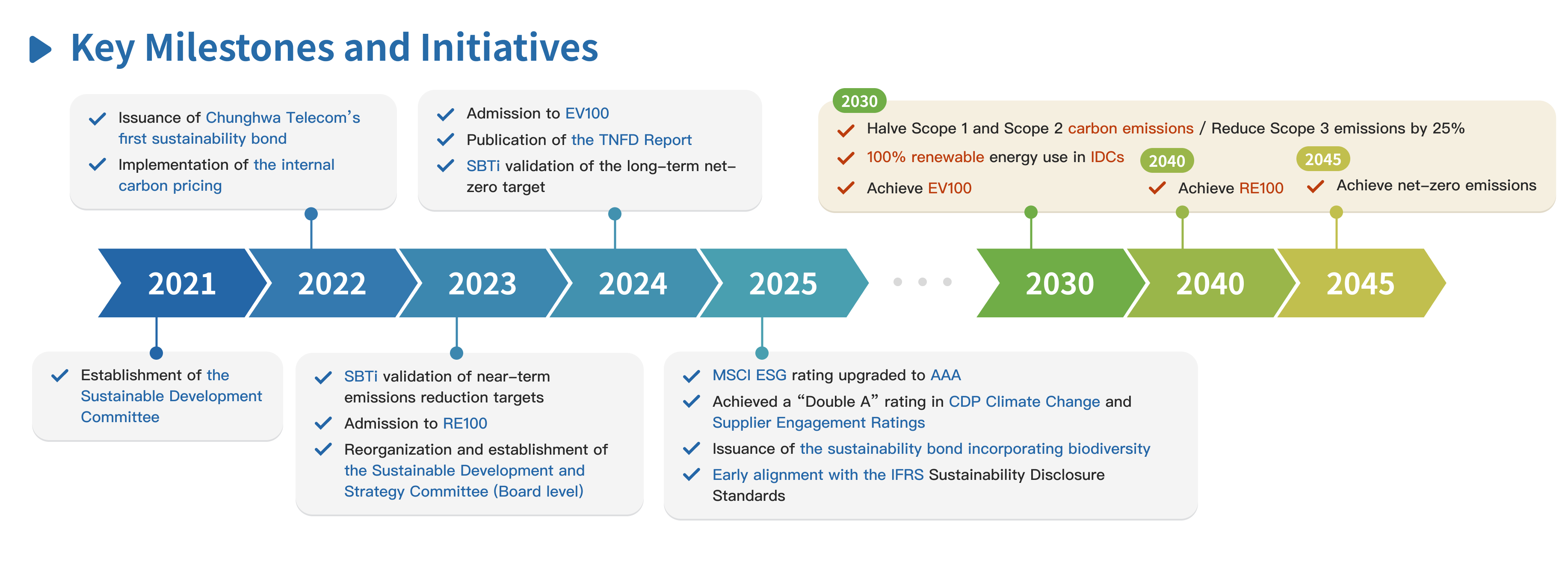
| Initiative Action | Initiative Targets |
|---|---|
| Set SBTi Science-Based Emissions Reduction Targets |
By 2030
|
| Join the RE100 Initiative |
By 2040
|
| Join the EV100 Initiative |
Before 2030
|
Chunghwa Telecom promotes multiple key decarbonization actions across Scope 1, Scope 2, and Scope 3 emissions in accordance with its SBTi-validated decarbonization pathway, supporting its 2030 near-term emissions reduction targets and 2045 net-zero emissions target.
| Emissions Scope | Decarbonization Lever | Key Actions | Targets / Results |
|---|---|---|---|
| Scope 1 | Vehicle Electrification | Promote EV100 and gradually replace fossil fuel-powered engineering and company vehicle fleet with electric vehicles to reduce fleet fuel consumption and direct emissions. |
|
| Scope 2 | Renewable Energy Use | Advance the RE100 pathway, expand renewable energy procurement and self-generated electricity for self-consumption, and reduce emissions from purchased electricity. |
|
| Scope 2 | Technology-Enabled Decarbonization in IDCs | Continue to promote data center energy efficiency by introducing high-efficiency chillers, water pumps rated IE3 or above, AI-powered smart energy-saving technologies, and direct liquid cooling solutions, gradually reducing the PUE of data centers. |
|
| Scope 2 | Replacement of Legacy Energy-Intensive Equipment | Continue replacing legacy energy-intensive equipment, including power, air-conditioning, switching, transmission, access network, and mobile device, to improve overall energy use efficiency. |
|
| Scope 3 | Supplier Product Carbon Footprint Management | For tenders with a contract value exceeding NT$30 million, suppliers are required to provide product carbon footprint data for verification. |
|
| Scope 3 | Supplier Carbon Management Capability Grading and Guidance | Assess and grade suppliers’ carbon management capabilities and provide training and individual guidance. |
|
| Scope 3 | Product Environmental Footprint Category Rules and Low-Carbon Procurement | Chunghwa Telecom developed the “Product Environmental Footprint Category Rules (PEFCR) for User-End Network Communications Equipment” jointly with suppliers, and requires devices such as home gateways (HGW), Mesh APs, and MOD set-top boxes (STBs) to obtain ISO 14067 product carbon footprint certification and the Ministry of Environment's carbon reduction label as mandatory prerequisite for procurement. |
|
| Scope 3 | Sales of Low-Carbon Products | Sales products mainly consist of consumer electronics and home appliances with Grade 1 or Grade 2 energy-efficiency labels, and suppliers are required to provide carbon footprint data. |
|
| Scope 3 | Supply Chain Carbon Management Information System | A supplier supply chain carbon management information system has been established to monitor suppliers’ carbon emissions in a timely manner. |
|
- ➤ Principles for the Use of Carbon Credits
Chunghwa Telecom prioritizes absolute emissions reductions, including improving energy efficiency, introducing energy-saving technologies, and expanding the use of renewable energy. Upon achieving a certain level of value chain emissions reductions, the Company may, in accordance with SBTi standards and actual needs, prudently evaluate the use of high-quality carbon credits with international credibility as a supplementary instrument to achieve its net-zero target.
In 2023, Chunghwa Telecom purchased Gold Standard-certified carbon credits via the international carbon credit trading platform of the Taiwan Carbon Solution Exchange (TCX). These carbon credits have been used by the Chunghwa Telecom Training Institute by the end of 2025 for its application for ISO 14068-1 carbon neutrality verification.
Stakeholder Engagement
To support the effective implementation of its Net-Zero Transition Plan, Chunghwa Telecom has established regular stakeholder engagement mechanisms targeting three groups: the Value Chain, Industry Initiatives and Partnerships, as well as the Government, Public Sector, and Society. The Company periodically collects stakeholder feedback on its transition pathway, decarbonization targets, and supporting measures, and integrates such feedback into the review and adjustment of the transition plan, thereby strengthening execution capabilities and support from relevant parties.
| Engagement Target | Engagement Mechanism | Feedback Collected and Response Actions |
|---|---|---|
| Value Chain | Since 2017, Chunghwa Telecom has joined the CDP Supply Chain Program and has established various channels, including an annual supplier ESG assessment system, net-zero engagement meetings, low-carbon transition surveys, and joint net-zero initiative. |
|
| Customers and Downstream Customers | Chunghwa Telecom engages with customers through customer satisfaction surveys, carbon management consultation channels for enterprise customers, and product carbon footprint inquiry services. |
|
| Industry Initiatives and Partnerships | Chunghwa Telecom has joined international initiatives such as SBTi, RE100, EV100, TCFD, and CDP, and participates in domestic industry associations such as the Taiwan Telecommunication Industry Development Association. |
|
| Government, Public Sector, and Society | Chunghwa Telecom participates in policy advisory meetings, net-zero transition working groups, and regulatory consultation meetings held by competent authorities such as the Energy Administration, Ministry of Economic Affairs, the Ministry of Environment, and the National Communications Commission. |
|
Social Impact Assessment and Actions
Chunghwa Telecom recognizes that the low-carbon transition process may generate varying degrees of social impact on employees, supply chain partners, communities, consumers, and vulnerable groups. Therefore, in the implementation of its Net-Zero Transition Plan, the Company has introduced a social impact assessment mechanism. Guided by the principle of Just Transition, Chunghwa Telecom assesses the potential impacts of transition actions and mitigates potential impacts during the transition process through stakeholder engagement, employee capacity building, supply chain guidance, digital equity, and communications resilience enhancement. These actions ensure that the benefits of the transition take into account business operations, social inclusion, and stakeholder needs.
Social Impact Assessment Process
Chunghwa Telecom adheres to the cyclical framework of “identify, assess, respond, and monitor” and incorporates social impact assessment into the implementation and review process of its Net-Zero Transition Plan, ensuring that relevant actions respond to the needs of diverse stakeholders.
| Assessment Process | Implementation Approach |
|---|---|
| Identify | Through stakeholder engagement, industry trend reviews, and internal management processes, Chunghwa Telecom identifies social risks and opportunities that may be associated with the low-carbon transition. |
| Assess | Based on the impacted groups, scope of impact, and potential impacts on human rights or social inclusion, Chunghwa Telecom assesses the potential impacts that different groups may be exposed to during the transition process. |
| Respond | For identified social impacts, Chunghwa Telecom plans corresponding measures and incorporates them into annual implementation plans or relevant project execution. |
| Monitor | Through collaboration among relevant units, progress reviews, and stakeholder feedback, Chunghwa Telecom tracks the implementation of response measures and leverages the results as a basis for subsequent adjustments. |
Social Impact Assessment and Response Measures under the Net-Zero Transition Plan
| Impacted Group / Scope | Potential Social Impact | Chunghwa Telecom's Response Actions |
|---|---|---|
| Consumers and Communities: Operational Resilience | Climate change may increase the frequency and intensity of extreme events, such as typhoons, torrential rainfall, earthquakes, and rising sea temperatures, impacting the reliability and accessibility of telecommunications infrastructure and communication services. |
|
| Vulnerable Groups and Remote Communities: Digital Equity | The low-carbon transition and digitalization process may exacerbate the digital divide for groups such as remote communities, offshore islands, individuals with disabilities, low-income households, and the elderly, impacting their access to disaster prevention information, telemedicine, education and learning, and economic participation opportunities. |
|
| Small and Medium-Sized Enterprises: Digital Capability Building | Small and medium-sized enterprises (SMEs) may face challenges related to insufficient technology, human resources, and management capabilities during the low-carbon transition and digital transformation process due to limited resources. |
|
| Enterprise Customers and Consumers: Accessibility to Low-Carbon and Digital Services | During the low-carbon transition, different industries and consumer groups have increasing demand for digital infrastructure, low-carbon services, and convenient communication services. |
|
| Employees: Sustainable Talent Development | The net-zero transition may entail function adjustments and demands for emerging professional capabilities. It is necessary for employees to possess knowledge related to sustainability, decarbonization, and climate issues to align with the transition direction of the Company. |
|
| Management and Governance Level: Climate Decision-Making Capability | The net-zero transition involves adjustments to strategy, investment, risk management, and operations, requiring strengthened decision-making capabilities among the management regarding climate-related issues and transition pathways. |
|
| Employees: Vehicle Electrification | The electrification of engineering and company vehicle fleet may impact frontline employees’ vehicle usage habits, maintenance awareness, charging convenience, and range arrangements. |
|
| Supply Chain Partners: Carbon Management and Decarbonization Requirements | Suppliers may experience pressures related to implementation capabilities, costs, and data collection in the face of Chunghwa Telecom's requirements for carbon inventory, product and service carbon footprints, net-zero commitments, and decarbonization capacity building. |
|
| Supply Chain Partners: Implementation Challenges and Capacity Building | Suppliers have reported practical challenges, including difficulties in acquiring upstream carbon data, defining the inventory boundaries for product or service carbon footprints, pressures related to third-party verification costs and timelines, methodologies for allocating carbon emissions in service contracts, material submission on the platform, and supporting evidence. |
|
Continuous Improvement of the Transition Plan
Chunghwa Telecom will continue to conduct rolling reviews of its response measures based on the implementation progress of the Net-Zero Transition Plan, stakeholder feedback, supply chain carbon management maturity, and social impact assessment results. Moving forward, the Company will continually revise procurement terms, platform workflows, training content, and supplier guidance measures, while strengthening employee capacity building, digital equity, communications resilience, and supply chain decarbonization management so as to ensure that the net-zero transition process takes into account operational resilience, social inclusion, and the rights and interests of stakeholders.