


Cybersecurity Commitment
A rock-solid secure ICT infrastructure is the foundation for any telecommunication services. The cybersecurity vision at Chunghwa Telecom (referred to as the Company hereinafter) is to “strengthen cybersecurity resilience and enhance privacy protection, creating a top-tier technology group that meets international standards for safety, reliability, and customer trust.” The Company formulated rigorous risk management and protection measures to uncover hidden, malicious behaviors and hunt down potential threats in time in the early stage of hacker attacks in a more proactively fashion. Meanwhile, with international cybersecurity standards introduced, it has established the joint defense mechanisms with governments and international cybersecurity organizations, effectively enhancing the overall cybersecurity defense and response capabilities of the Company and ensuring the security of operation and customer information.
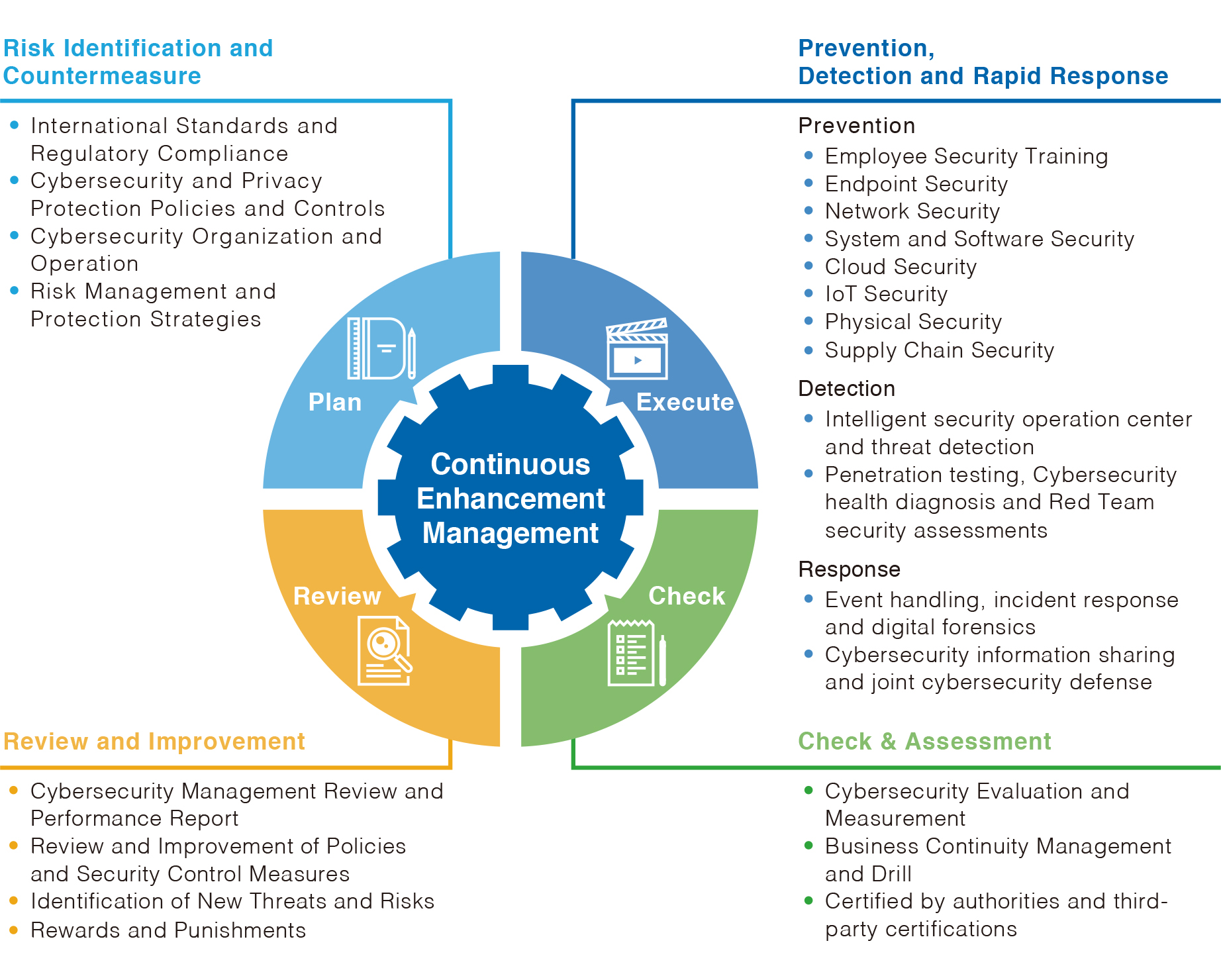
Aiming for “zero tolerance,” we implement “Cybersecurity Policy” and “Privacy Protection Policy” right from the start. Pursuant to the spirit of ISO 27001 Information Security Management System and the Plan-Do-Check-Act (PDCA) cycle, we constantly review and improve in these regards before embedded into the everyday operations, so as to achieve the goal of ZERO occurrence in both major cybersecurity breach and privacy incidents.
➤ Check out our 《 Cybersecurity Policy 》
Cybersecurity Management Strategy and Structure
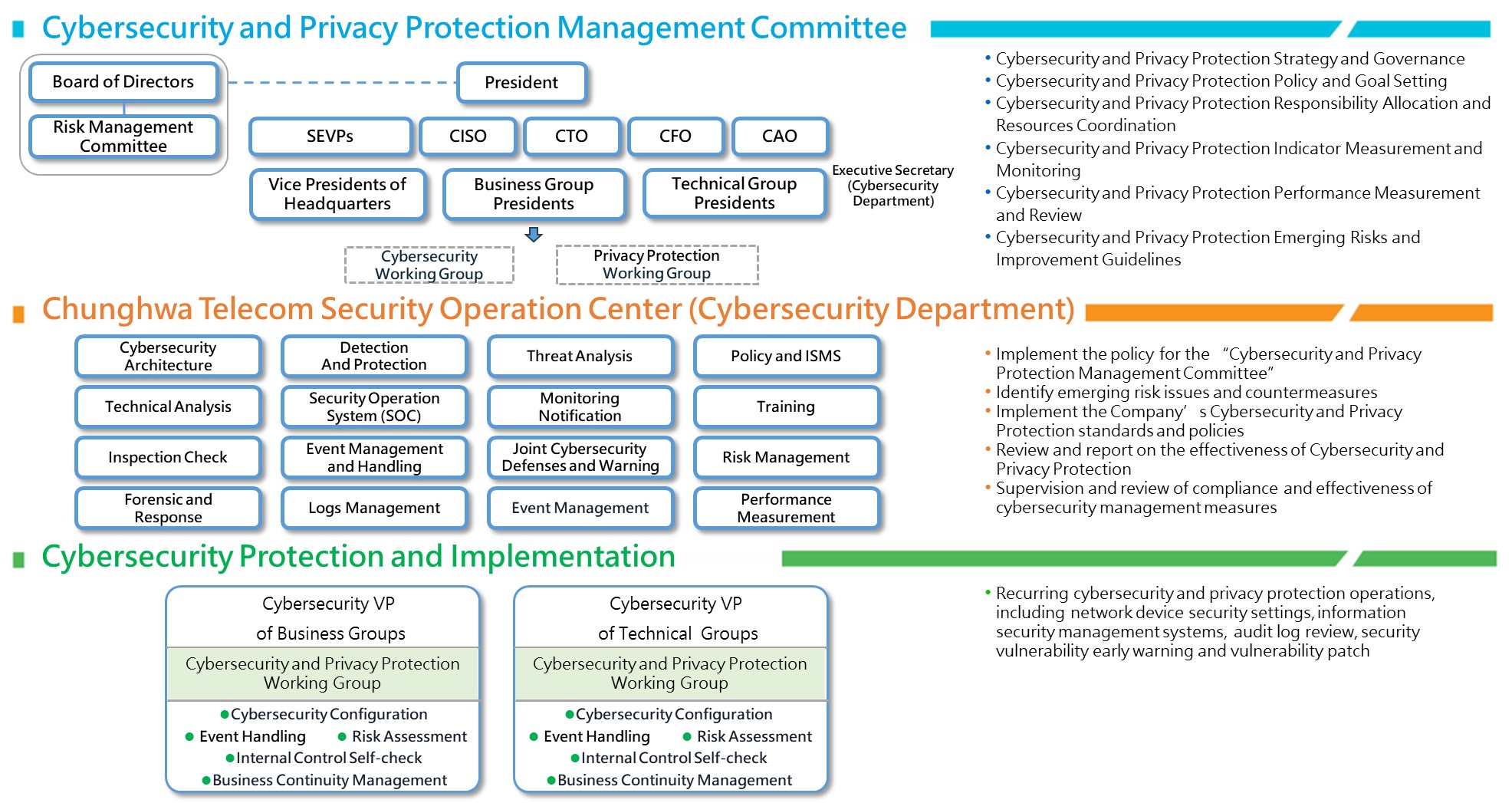
Cybersecurity Management Organizations
| Item | Description |
|---|---|
| Risk Management Committee established under the Board of Directors |
|
| Cybersecurity and Privacy Protection Management Committee |
|
| Regular meetings |
|
Cybersecurity Management Organizations at CHT
Management Mechanisms
- Chunghwa Telecom has established the information security management system that meets international standards. Driven by the risk management principles, it updates its Cybersecurity Policy and related guidelines according to the external and internal risk assessment results every year.
- To ensure the security of “ICT systems” and “critical infrastructure,” with reference to the NIST Cybersecurity Framework (CSF 2.0), Chunghwa Telecom established “Cybersecurity and Privacy Protection Risk Management Framework” to put in place and effective measures for “cybersecurity” and “privacy protection” so as to prevent any potential cybersecurity risk.
- To support and achieve the strategies and goals of businesses, the Company has established the “Cybersecurity Policy” in line with the operational goals. CHT declares its commitment to achieving “Zero Tolerance” for cybersecurity incidents to all employees, customers, and suppliers.
- To enforce specific and effective measures for cybersecurity and privacy protection, including real-time incident report, critical infrastructure management, and third-party external cybersecurity testing, etc. Following the PDCA management cycle, the Company constantly improves management practices in cybersecurity and privacy protection on a rolling basis.
For more information, please refer to the company's annual report. ( access the company's annual report )